5/12 每日一題
Given head, the head of a linked list, determine if the linked list has a cycle in it.
There is a cycle in a linked list if there is some node in the list that can be reached again by continuously following the next pointer. Internally, pos is used to denote the index of the node that tail's next pointer is connected to. Note that pos is not passed as a parameter.
Return true if there is a cycle in the linked list. Otherwise, return false.
Example 1:
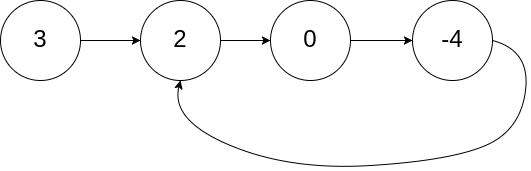
Input: head = [3,2,0,-4], pos = 1
Output: true
Explanation: There is a cycle in the linked list, where the tail connects to the 1st node (0-indexed).
Example 2:
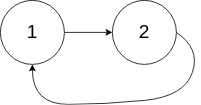
Input: head = [1,2], pos = 0
Output: true
Explanation: There is a cycle in the linked list, where the tail connects to the 0th node.
Example 3:

Input: head = [1], pos = -1
Output: false
Explanation: There is no cycle in the linked list.
Constraints:
- The number of the nodes in the list is in the range
[0, 104]. -105 <= Node.val <= 105posis-1or a valid index in the linked-list.
Follow up: Can you solve it using O(1) (i.e. constant) memory?
# Definition for singly-linked list.
# class ListNode:
# def __init__(self, x):
# self.val = x
# self.next = None
class Solution:
def hasCycle(self, head: Optional[ListNode]) -> bool:
#定義2個快慢指針,如果最終會相遇,那必定循環,如果塊遇到None,那就不是循環
#首先把快慢指向標頭
slow=head
fast=head
while fast: #在快指針遇到None之前一直循環
if fast.next !=None:
fast=fast.next.next
else:
return False
slow=slow.next #一次一步
if fast == slow:
#這邊不能使用fast.val比較,因為可能在不同節點出現相同的值
return True
張貼者:踏上開始的旅途 @ 5月 11, 2023
0 個意見


0 個意見:
張貼留言
訂閱 張貼留言 [Atom]
<< 首頁